Carton Flow Rack Guide
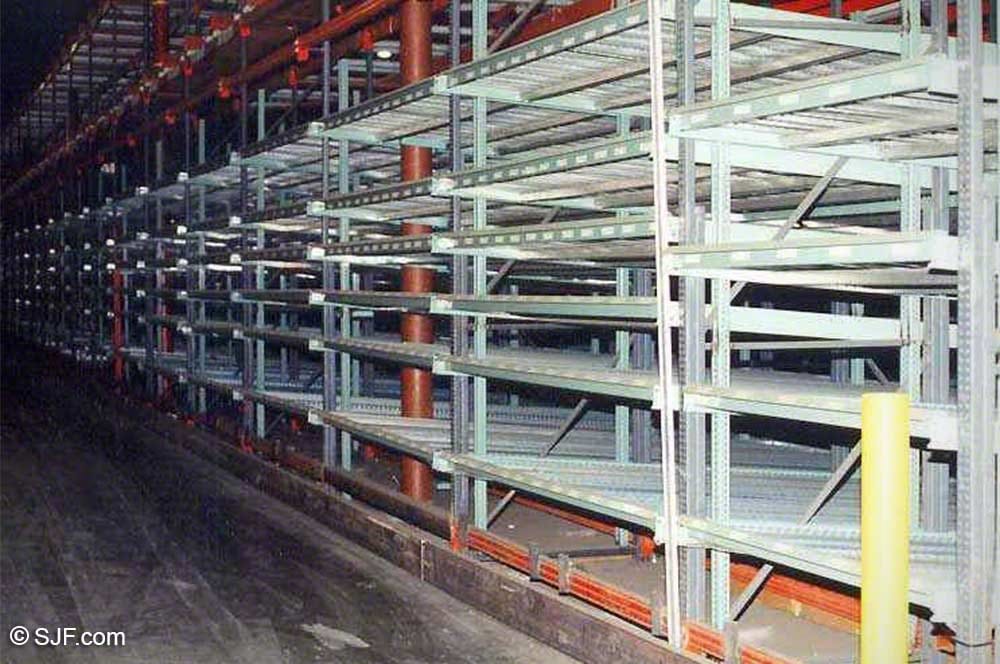
Put simply, the main advantage of carton flow rack is that merchandise remains better organized and easier to
find/pick. With carton flow rack, the product is automatically rotated on a first in first out basis. The concept is
simple and effective. Merchandise is stocked in the rear of the carton flow rack and moves toward the picking station
in front on an inclined shelf equipped with specially designed roller track. When a carton is removed from the picking
station, the next one in line rolls to the front. Carton flow is a great system that always keeps items within reach.
Inventory is easier to monitor and control since products are fully visible at all times.
Restocking and picking typically offer the greatest opportunity for improving efficiency. With carton flow rack systems
labor savings of up to 75% can be realized almost immediately. Because items are picked from the front and stocked from the
rear, both functions can be performed without interference and with minimized travel.
In a static storage system such as standard shelving, the stockers and pickers are often doing a lot of unnecessary work,
leading to decreased productivity. Although the static storage systems may be less expensive in the short term, in the long
run they can cost you more than they initially save, especially compared with a flow rack system.
Static Rack vs. Dynamic Storage Systems
Figure 1 shows a very clear comparison between static and dynamic racks. In the static system, the stockers and pickers
are taking far more steps than are necessary to accomplish their tasks. They may not always take the most efficient path
to the product and they will almost certainly get into each others' way at some point. In the dynamic system, the first
thing to notice is that both the stockers AND the pickers have much less distance to walk. This allows them to concentrate
on stocking and picking and will allow them to get more work done. Also notice that in the same amount of space that was
designated for static storage there is far more storage space available because the space is used much more efficiently.
Since stocking and picking operations are now seperate, neither worker will interfere with the others' work.
Carton Flow Rack Components
Like other storage racks, carton flow rack is modular and consists of many individual components. Units can be strung
together utilizing 'starter' and 'adder' sections to create entire rows of carton flow storage. There are also several
distinct types of carton flow frames and shelves that can be utilized in a variety of situations (see figures 2 & 3).
The most common types of carton flow frames are square front and layback. Square front carton flow frames are useful for
picking full cases. Applications include canned goods, liqour, parts, etc. Layback carton flow frames are useful when picking
from open cases. Applications may include health & beauty products, books, or other situations where the cases are differently
sized. Another advantage to layback frames is that it is easier for workers to access the middle and lower shelves. This is
typically where you'd store your highest turnover merchandise, thus creating faster and more efficient picking.
There are also several different types of carton flow shelves that assist in different picking applications. Straight
shelves are the most common type of carton flow shelf, and are most commonly used when picking full cases. Knuckled shelves
are the second most common carton flow shelf type and are useful for picking individual items from the cartons. Weld-in
trays are similar to knuckled shelves but provide a larger access space from which to pick items. Finally, reverse knuckled
shelves are useful for split case picking when the items are picked from the front of the cartons.
Roller track (figure 4) is at the heart of carton flow rack's operation. It is on these tracks that the actual product
(in boxes or cartons) rolls forward towards the front of the rack. Typically, these rollers are used in pairs to form 'lanes' in each
carton flow shelf. These lanes keep similar products seperated. Shelf guides work with the roller track to keep product seperated.
The guides are placed between lanes to keep products rolling in their specific lanes so they do not cross over into other lanes
on the carton flow shelves. Carton flow clips hold the carton flow shelves to the frames. Some of these clips can also be used
with regular pallet rack frames to allow you to create a mix of carton flow rack and pallet rack in the same vertical space.
SJF carries most major brands of carton flow racking. This includes the frames, shelves, rollers, guides, clips - anything
you would need to assemble a complete carton flow rack. Whether you need one section or 1000, SJF's friendly knowledgeable
staff can help you find the carton flow rack you need. Call today to see what a dynamic storage system can do for your business. [800-598-5532]
SJF
on Google+
Recent Tweets From @SJF_com