
Story Highlights
- Most warehouse designs are built around square footage, not inventory data, and that disconnect shows up fast once operations get moving
- SKU velocity analysis reveals which products deserve prime storage real estate, and which ones can sit in the back without hurting performance
- The right rack type depends on how a SKU actually moves, not on what equipment is already in place or what seems familiar
Before buying a single rack or laying out a single aisle, there is a question worth asking: what are the SKUs actually doing?
Most warehouse designs start with square footage and end with whatever rack style seems familiar. That approach works - until it doesn't. When orders slow down, pickers walk too far, and space fills up with product that barely moves; the design itself is usually the problem. And it usually traces back to skipping the inventory analysis step.
SKU profiling, sometimes called inventory profiling, is the process of looking at inventory data and understanding how each product moves. How fast does it sell? In what quantities? Does it spike seasonally? Does it ship as a full pallet or as individual picks? The answers to those questions should drive storage decisions - not assumptions.
SKU profiling should also be paired with order profiling. SKU data identifies what is stored and how frequently each product moves, while order data shows how products are combined and fulfilled. Lines per order, units per line, full-pallet versus case or each-pick activity, order frequency, carrier cutoff times, and peak-hour demand all influence storage placement, picking methods, forward-pick capacity, packing requirements, and shipping flow.
Before SKUs are categorized, the underlying data should be reviewed for accuracy and consistency. Product dimensions, weights, units of measure, inventory balances, location records, and transaction history all affect the analysis. Missing or inaccurate information can produce precise-looking velocity classifications and storage recommendations that do not reflect actual operating conditions.
What SKU Velocity Actually Shows
SKU velocity is a measure of how quickly a product moves through a warehouse in a given time period. It sounds simple, and it is - but most operations don't use it consistently when making storage decisions.
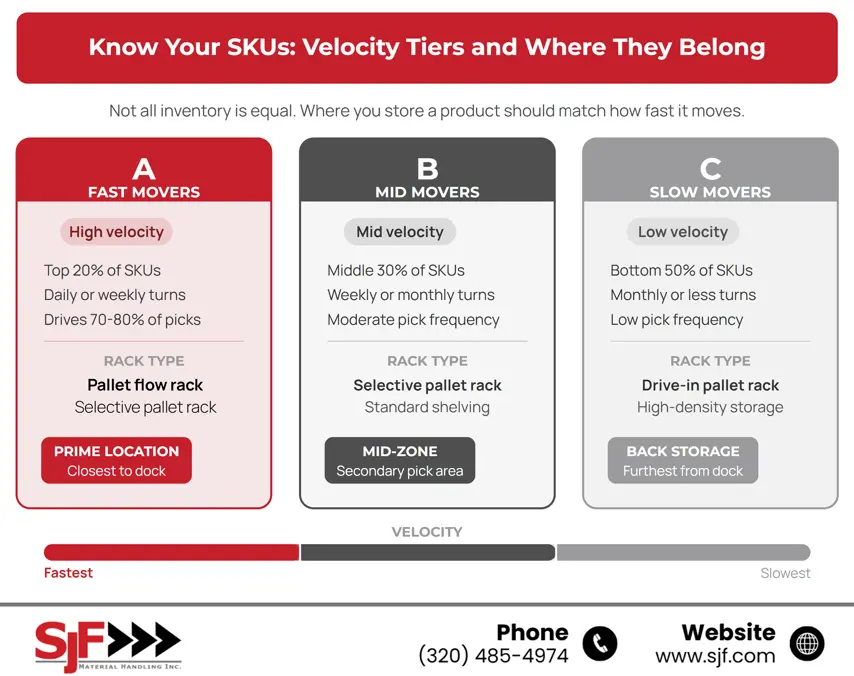
A basic SKU velocity calculation looks at units sold or shipped over a defined window (30, 60, or 90 days is common) and categorizes products into tiers. Fast movers, sometimes called A-movers, are the top sellers. B and C movers are progressively slower. Dead stock is everything that barely moves at all.
Velocity shows how often a SKU needs to be touched. It doesn't show how it should be picked. That's a separate question, and it matters just as much.
Once velocity tiers are established, a few important things become clear:
- Fast movers are often candidates for prime forward locations. Positioning frequently picked products near their next process step can reduce travel, but final placement should also account for replenishment traffic, congestion, product weight, handling requirements, and order affinity.
- Slow movers can often use less accessible or higher-density locations. Because they are handled less frequently, they may not require prime pick positions, provided their storage method still supports safe access, rotation requirements, and the way they are picked.
- Dead or inactive stock should be identified early. Products with little or no movement can consume valuable capacity, but disposition decisions should account for seasonality, service parts, contractual inventory, and other legitimate reasons for extended storage.
Movement frequency should also be considered alongside the physical characteristics of the product. Dimensions, weight, pallet quality, stackability, fragility, load stability, and handling requirements affect where a SKU can be stored and what equipment can safely move it. Cube movement, the volume of product moving through the warehouse over time, can be more useful than unit velocity alone when products vary significantly in size.
Similarly, velocity alone doesn't show which rack type fits. That comes down to how the SKU is picked - full pallet, full case, or broken case - and that question cuts across all three tiers. A slow-moving SKU that ships by the case needs the same kind of pick-face access as a fast-moving one. The rack decision depends on pick type as much as it depends on speed.
Matching Rack Type to How Inventory Actually Moves
Once velocity tiers and pick patterns are understood, storage types can be matched to product behavior instead of forcing product into whatever is already in place. Here is how the main rack types map to real inventory movement.
No storage system maximizes every objective at once. Greater density may reduce direct access or flexibility. Greater accessibility may require more aisle space. Flow systems can improve rotation and presentation but require more disciplined lane sizing and replenishment. Storage selection should therefore balance density, accessibility, selectivity, throughput, product rotation, flexibility, equipment requirements, and total cost.
Selective Pallet Rack: The Foundation Most Warehouses are Built On
Selective pallet rack is where most warehouse storage systems start - and for good reason. Every position is independently accessible; beam heights are adjustable, and multiple SKUs can share the same bay without committing to a fixed product profile.
Selective rack is often a strong fit for SKUs that require direct pallet access, frequent re-slotting, or flexibility across a changing product mix. It may support A, B, or C-movers depending on the pick method, inventory depth, and throughput requirements. It provides access without the overhead of a gravity-fed system, and the flexibility to re-slot as inventory mix shifts.
Think of it as the backbone. Depending on the operation, selected fast movers may benefit from flow systems or larger forward-pick locations, while appropriate slow-moving or bulk inventory may be placed in higher-density reserve storage. The final mix should reflect a balance of pick type, inventory depth, rotation requirements, and replenishment strategy, while being aware of space constraints.
Carton Flow Rack: Built for Case Picking
Carton flow rack is a fulfillment center staple, built for broken case and full case picking. It uses gravity rollers to feed product from the back of the lane to the front - load from one side, pick from the other. It's a first-in, first-out (FIFO) system, which matters for perishables or date-sensitive inventory.
The defining factor for carton flow isn't velocity, it's pick type. Because gravity advances product toward the pick face, carton flow reduces the need for pickers to reach into deep shelving or manually pull inventory forward. Replenishment still occurs from the loading side, but it can be separated from picking activity and scheduled to reduce interference.
This allows it to work just as well for A, B, and C movers, as long as the SKU ships by the case or partial case rather than the full pallet. A fulfillment operation might run carton flow lanes across its entire SKU range, from its fastest sellers to its slowest, because the picking method is what matters, not the tier.
Pallet Flow Rack: For Full-Pallet Fast Movers
Pallet flow rack works on the same gravity-feed principle but handles full pallets instead of cartons. It's a good fit for high-velocity SKUs that ship in full pallet quantities and where FIFO rotation matters. It provides high-density storage in a compact footprint while separating loading and retrieval activities. Pallet flow is most effective when sufficient pallet depth exists for each SKU, load quality is consistent, FIFO rotation is required, and throughput justifies the added system cost and lane discipline.
Drive-In Pallet Racking: Density Over Speed
Drive-in pallet racking is built for density, not access speed. Forklifts drive into the rack structure to place or retrieve pallets, so inventory is accessed last-in, first-out (LIFO) - the most recently stored pallet is the first one available. For most mixed-SKU operations, that’s a limitation. But for slow-moving product or bulk storage of a single SKU where rotation isn't critical (think paper goods, beverages, or seasonal overflow), drive-in can make far better use of your cube than selective rack.
The key is not defaulting to one system for everything. A warehouse that uses selective rack wall-to-wall is often leaving capacity on the table, especially in the back half of the building where slow movers sit. The right mix of storage types, where not a single system is applied everywhere, is what gets the most out of your footprint.
Racking System Selection at a Glance
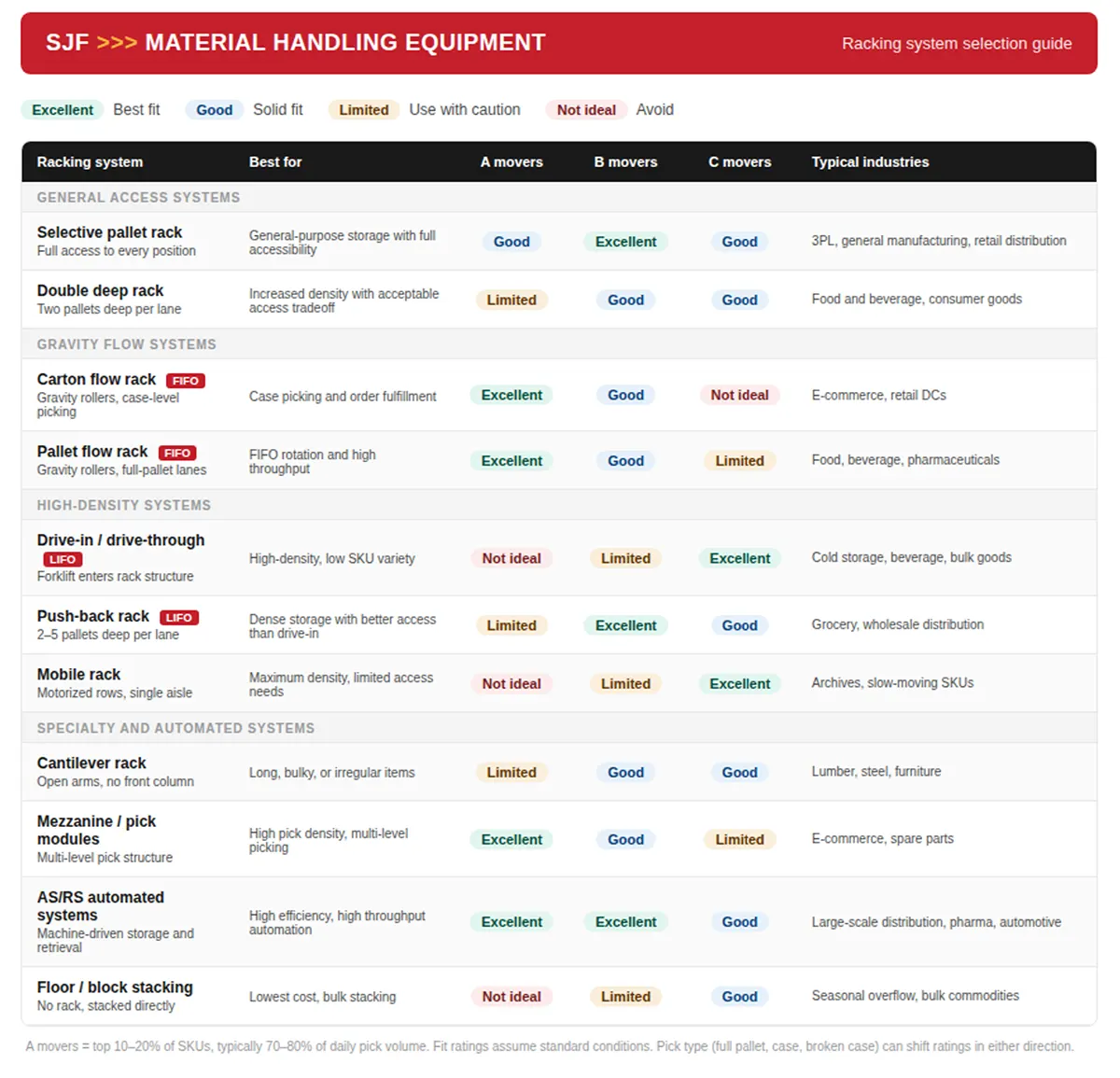
The sections above cover the four most common systems in depth, but the full range of options is broader. The reference chart below provides a high-level comparison of common storage systems. Velocity is only one consideration; pick type, pallet depth, rotation requirements, load characteristics, and throughput can change the fit.
The sections above cover the four most common systems in depth, but the full range of options is broader. The reference chart below provides a high-level comparison of common storage systems. Velocity is only one consideration; pick type, pallet depth, rotation requirements, load characteristics, and throughput can change the fit.
A few things to keep in mind: the fit ratings assume standard conditions. The pick type (full pallet, full case, or broken case) can shift a rating in either direction, and some systems that look limited for A movers become the right call when rotation requirements or throughput volume changes the equation. Use it as a starting point, not a final answer.
Seasonal Inventory Changes the Equation
Seasonal inventory management adds a layer of complexity that point-in-time velocity snapshots won’t capture on their own. A product can be a slow mover for 10 months and an A-mover for two. If the storage design is based on annual averages, operations will fight their own layout every peak season.
The better approach is to look at velocity by month, not just total volume. For operations with short promotional or event-driven peaks, monthly averages may still hide the actual requirement. Weekly or daily transaction data may be needed to identify how high demand rises, how long the peak lasts, and whether temporary slotting, overflow storage, or additional forward-pick capacity is required. That shows when products shift tiers and how dramatically. From there, designs can build in flexibility - whether that means adjustable configurations, overflow zones, or designated seasonal staging areas that don't disrupt the core pick paths.
Fast-moving and slow-moving aren’t permanent categories. Reviewing velocity data quarterly, or ahead of known peak periods, allows re-slotting before product ends up in the wrong place, not after the operation is already buried in it.
Inventory Turnover Rate: The Bigger Picture
Inventory turnover rate tells how many times the total inventory cycles through in a year. It is a useful metric for benchmarking overall warehouse efficiency and for spotting dead weight in a storage system.
A low turnover rate often signals too much slow-moving or obsolete inventory occupying space, which means either overcrowding or underuse of the building. Either way, it shows up in operational costs.
High turnover sounds good, but it can also mean the operation is running lean enough that stockouts become a real risk. The goal isn't the highest possible number. It is a turnover rate that matches the business model and gives the storage system room to function without constant firefighting.
Understanding where an operation lands helps design a warehouse storage system that handles actual flow, not an idealized version of it.
Data to Review Before Selecting a Storage System
- SKU dimensions, weight, and load characteristics
- Average and peak inventory by SKU
- Pick frequency or order lines by SKU
- Full-pallet, case, and each-pick percentages
- Lines and units per order
- Seasonal and promotional demand
- Product affinity and common combinations
- Rotation and expiration requirements
- Replenishment frequency
- Inventory and location accuracy
Conduct SKU Profiling Before Designing
The sequence matters. SKU profiling and SKU velocity analysis should happen before any warehouse design decisions are made - not after being already committed to a racking system.
When SJF works through a warehouse design project, the inventory data conversation happens early. What is being stored? How does it move? What are the peak volumes? Those answers shape everything else - aisle width, rack height, system type, pick path logic.
Getting it right on the front end means fewer compromises once it's operational. Getting it wrong means adapting a layout that was never built for the actual inventory - which is a much harder problem to solve.
Need help figuring out the right storage mix?
SJF has been designing storage systems around real inventory data since 1979. If the SKUs are known but the right storage systems are not, that is exactly where SJF starts. Contact the SJF team about the warehouse design or browse warehouse storage solutions to see what fits the operation.
Storage Systems
Discovery & Needs Assessment Series
Article 1: "7 Keys for Efficient Warehouse Design and Performance"
Article 2: "SKU Profiling: How Inventory Data Should Drive Warehouse Design" (this article)
Article 3: "Warehouse Throughput Math"
Article 4: "Turning Warehouse Findings Into an Improvement Plan"
Article 5: "Optimize, Expand, or 3PL? Evaluating the Right Path for a Warehouse Operation"
Article 6: "Designing a Warehouse That Can Adapt: How to Avoid Obsolescence in Three Years"