Story Highlights
- Fixed automation adoption is climbing across distribution, with conveyor and sortation systems among the most widely deployed technologies in the industry
- Fixed automation delivers the lowest cost per unit at volume, with well-maintained systems offering a long operating life and strong return over time
- Investment in conveyor infrastructure has grown steadily year over year, driven by demand from distribution, e-commerce, and manufacturing operations of all sizes
The conversation around warehouse automation has shifted a lot in recent years. AMRs get the press. Robotics startups pull in the funding. And somewhere in all that noise, conveyors and sortation systems keep quietly moving the bulk of the world's freight.
There is a reason for that. Fixed automation, the conveyor lines, sortation equipment, pick modules, and carton flow lanes engineered into a facility, still handles the heaviest workloads in distribution. Not because it is the oldest option, but because for the right operation, nothing else comes close.
Here is what you need to know about fixed automation in 2026: where it fits, what it costs, and how the technology has changed.
What Fixed Automation Actually Does
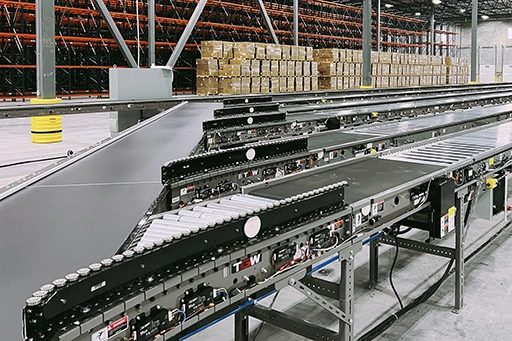
At its core, fixed automation moves product from point A to point B, repeatedly, at high speed, without a person carrying it. Conveyor systems transport totes, cartons, and packages along engineered paths. Sortation systems sit downstream and route each item to the right lane, chute, or staging area based on barcode data, weight, or destination.
Together they form the circulatory system of a high-volume DC. Receiving feeds into storage. Storage feeds into pick zones. Pick zones feed into packing. Packing feeds into shipping. When that flow is well-designed, a facility can process tens of thousands of orders a day with a fraction of the labor it would otherwise need.
The equipment range is wide. Gravity and powered roller conveyors handle basic transport. Belt conveyors move lightweight or irregular items. Accumulation conveyors create buffers between zones so product does not back up when a downstream area slows. Sortation systems, from sliding shoe sorters to cross-belt and wheel divert units, handle the high-speed routing work that once required rows of people manually reading labels and throwing packages into bins.
SJF carries one of the largest inventories of new and used conveyor systems in the country. If you are evaluating options, their team can match the right equipment to your product profile and throughput goals. Browse types of conveyor systems at SJF.com.
The Numbers Behind the Decision
Fixed automation is not cheap to install. Engineering, equipment, controls, installation, and commissioning on a mid-size system can run from several hundred thousand dollars into the millions depending on complexity.
But the ROI math often works in its favor at volume. Industry adoption of conveyor and sortation systems continues to climb, and for good reason: at high throughput, fixed automation drives down cost per unit moved faster than almost any alternative.
Total cost of ownership is where it really makes its case. A well-maintained conveyor system has a long operating life, and the upfront investment spreads across years of reliable throughput rather than landing all at once. The conveyor system market reflects this confidence, with investment growing steadily year over year driven by sustained demand from distribution, e-commerce, and manufacturing operations of all sizes.
For operations with tighter budgets, used and refurbished equipment is worth a serious look. SJF stocks over three miles of conveyor inventory, with refurbished systems often priced 30 to 80% less than new. See used gravity conveyor options and used powered conveyor options at SJF.com.
Where Fixed Automation Performs Best
Not every operation is the right candidate. Fixed automation earns its keep under specific conditions.
High daily volume is the clearest signal. If you are moving 20,000 or more units per day through consistent, repeatable flows, a fixed system will almost always outperform alternatives on a cost-per-unit basis. The speed advantage compounds over time.
Stable product profiles matter too. Fixed systems are built around specific product dimensions, weights, and handling requirements. A predictable SKU catalog and consistent carton sizes make a natural fit.
Long facility commitments seal the case. If you are in a building for five or more years with strong volume commitments, the ROI gets much easier to justify. High-capacity fulfillment centers consolidating multiple nodes are a particularly strong use case right now, where sortation systems route product across dozens of lanes simultaneously at speeds mobile solutions cannot match.
Sortation systems at SJF are available in wheel divert, cross-belt, and sliding shoe configurations to fit different product types and throughput requirements.
How Fixed Automation Has Changed
The old knock on fixed automation was rigidity. You install it, it does one thing, in one place, forever. That is increasingly outdated.
Modern systems are built with modularity in mind. Zones, buffers, and handoff points let operations reconfigure flows without tearing out entire lines. Warehouse Execution Systems (WES) now sit between the WMS and the physical equipment, coordinating flow in real time, prioritizing work, managing buffers, and clearing bottlenecks before they hit throughput.
AI-driven sortation is gaining ground too. Where older sorters followed fixed routing rules, newer systems use vision intelligence and adaptive logic to handle greater SKU diversity with fewer exceptions and less manual intervention.
Fixed automation is still anchored in place. It is considerably more responsive than it used to be.
The Bottom Line
Fixed automation is not going anywhere. Conveyors and sortation remain the most widely deployed automation technology in distribution, and the hybrid approach, fixed infrastructure for the high-throughput core, mobile automation at the edges, is fast becoming the standard design model. For high-volume operations with stable flows and long facility commitments, fixed automation is still the most reliable way to move product fast, cut labor costs, and build an operation that handles serious throughput day after day. SJF has been helping operations design and install conveyor and sortation systems for almost 50 years. Start with a warehouse consultation at SJF.com.