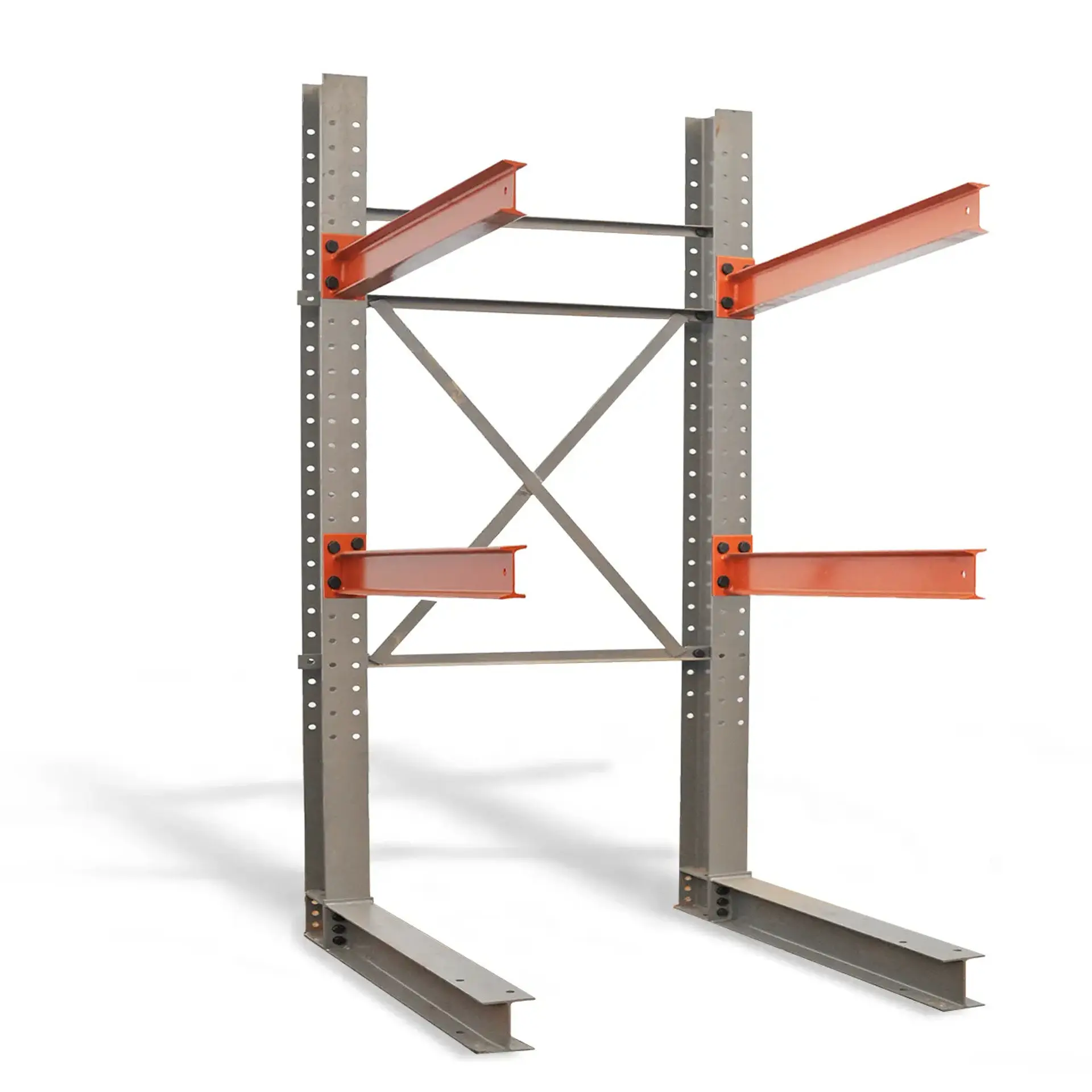
Cantilever racking is a heavy-duty industrial storage system designed specifically for long, bulky, or irregularly shaped materials that standard pallet rack cannot accommodate. Unlike pallet racking, cantilever systems have no vertical front posts — storage arms extend horizontally from a central upright column, leaving the face of the rack completely open for easy forklift access and unrestricted load lengths. The result is a storage system that can handle lumber, steel bar stock, PVC pipe, plywood, furniture, and other long or awkward materials at densities that floor stacking simply can't match. Cantilever racking is also referred to as cantilever shelving — particularly in retail and light-industrial settings — and the terms cantilever system and cantilever systems are used interchangeably throughout the industry. SJF Material Handling has been designing, supplying, and installing cantilever racking systems for warehouses across the U.S. for more than 40 years.
Cantilever Racking Definition
Talk to a Specialist
SJF Material Handling has been designing, supplying, and installing cantilever racking systems for over 40 years. If you'd rather talk through your options than read a guide, we're here.
How Cantilever Racking Works - The Four Core Components
Cantilever rack is a modular system built from four structural components that work together to create bays and rows of open-face storage. Understanding what each part does helps you configure a system for your specific load types and facility footprint.
Arms
Arms are the horizontal extensions that create each storage level. They connect to the upright column and protrude outward to support loads from below. Arms are adjustable on 4-inch increments, so you can dial in the exact shelf heights your material requires. Two arm styles exist: straight arms for flat materials like lumber and plywood that won't roll, and inclined arms (pitched at 20 degrees) for round materials like pipe, conduit, or tube stock that could otherwise roll off. Some arms include an end lip to prevent materials from slipping forward. Arm rated capacity decreases as arm length increases — shorter arms hold more per arm.
Uprights
The upright column is the backbone of any cantilever rack system. Uprights can be configured for single-sided use — arms on one side only, typically placed against a wall — or double-sided use, with arms extending from both sides to create a freestanding row accessible from either aisle. Uprights are available in a range of heights, most commonly 96", 120", 144", and 192", and must be matched to the correct base and arm series from the same manufacturer.
Bases
Bases bolt directly to the uprights at floor level and serve as the primary stabilizing anchor for the entire column. They distribute the vertical load outward along the floor and counterbalance the weight stored on the arms. Base depth is selected based on arm length and maximum load weight — the longer and heavier the load, the deeper the base needs to be.
Braces
Braces connect adjacent uprights along a row, providing horizontal and diagonal stability. They are structural connectors, not load-bearing shelves — nothing should be placed on bracing. Brace length matches the upright spacing in the installation. Horizontal braces and X-braces are the two standard configurations, with X-bracing providing additional lateral stability for taller or heavier systems.
Roll-Form vs. Structural Cantilever Rack — Which Do You Need?
The most important configuration decision in a cantilever racking project is whether to use roll-form or structural rack. They serve different load ranges and have different installation, cost, and durability profiles.
Structural Cantilever Rack
Structural cantilever rack is built from hot-rolled C-channel structural steel and assembled with hardware connections — nuts and bolts at every joint. This construction makes structural rack significantly heavier and more impact-resistant than roll-form, and capable of handling arm loads above 1,500 lbs. Structural cantilever is the standard for industrial applications: lumber yards, steel service centers, pipe and conduit distribution, building material warehouses, and any operation where forklifts are loading long, heavy materials onto the rack daily. SJF's structural cantilever systems are engineered to AISC (American Institute of Steel Construction) standards, which meets or exceeds RMI standards.
Roll-Form Cantilever Rack
Roll-form cantilever is manufactured from lighter-gauge formed steel and uses a bolt-less arm connection — arms clip or hook directly onto the upright column without nuts and bolts. This makes roll-form faster to install, easier to reconfigure, and less expensive to ship given its lighter weight. Roll-form is the right choice for light-to-medium duty applications: furniture storage, retail display, motorcycles, boats, jet skis, and similar items that stay well under 1,500 lbs. per arm. Roll-form can also be decked with wire or board to create conventional cantilever shelves for oddly shaped items, making it a practical cantilever shelving system for retail display, furniture showrooms, and light manufacturing.
Structural vs. Roll-Form Cantilever - At a Glance
| Structural | Roll-Form | |
|---|---|---|
| Load capacity per arm | Heavy duty (1,500 lbs. and above) | Light to medium duty (under 1,500 lbs.) |
| Connection type | Bolted connection | Bolt-less/clip |
| Installation speed | Slower | Faster |
| Shipping cost | Higher (heavier) | Lower (lighter) |
| Impact resistance | High | Standard |
| Best for | Lumber, pipe, bar stock, steel | Furniture, boats, light material |
Single-Sided vs. Double-Sided Cantilever Racking
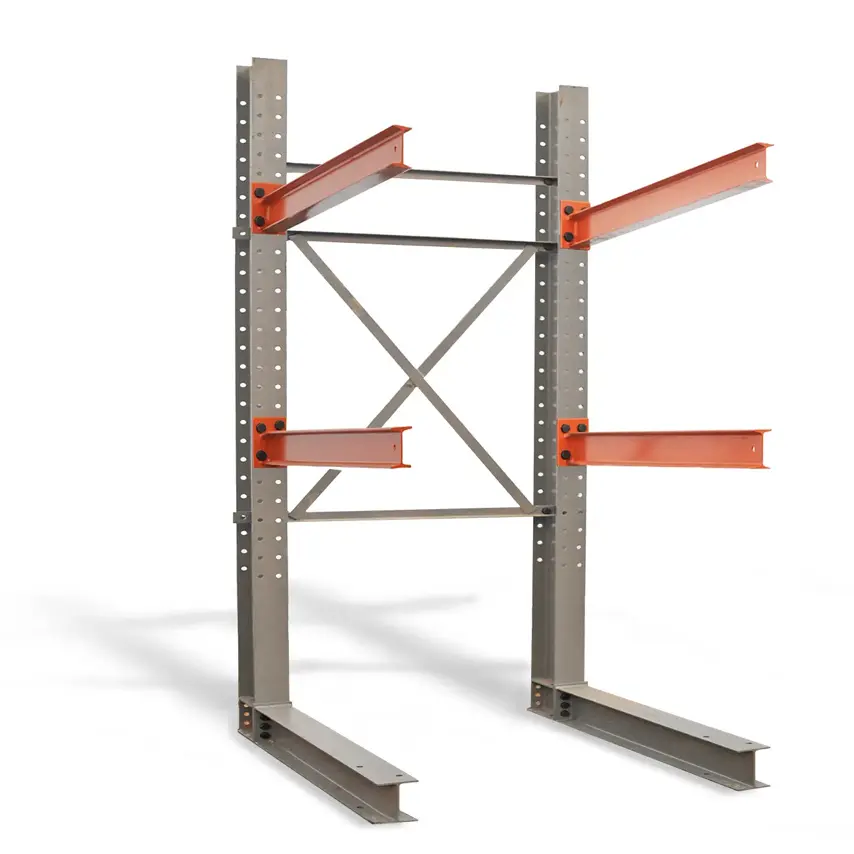
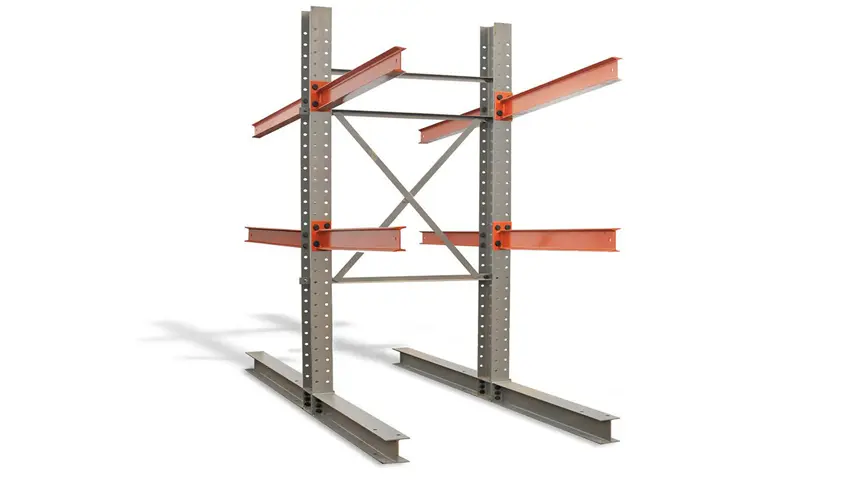
Cantilever uprights are available in two configurations: single-sided and double-sided. Single-sided units have arms on one face only and are typically positioned against a wall to use perimeter space efficiently. Double-sided units carry arms on both faces, creating a freestanding row that can be loaded and unloaded from both aisles simultaneously. Double-sided systems generally offer better storage density per square foot of floor space in the middle of a warehouse, while single-sided rows are the right choice when you're working with a column-lined wall or want to protect one aisle from forklift traffic.
Important safety note: Never install arms on the back side of a single-sided upright. Even when the upright has holes for arms on both faces, adding arms to the unsupported side creates a tip-over hazard that can cause serious injury or death. Single-sided systems are engineered and balanced for one-sided loading only.
What Can Cantilever Racking Store?
Cantilever rack is the go-to solution for any material that's too long, too awkward, or too variable in dimension for standard pallet rack. The absence of front columns means there's no practical limit on load length — a 24-foot steel I-beam can be staged just as easily as an 8-foot 2x4. Common applications include:
Long Raw Materials
Lumber, plywood, OSB, sheet rock, drywall, wood veneer, sheet stock, metal bar stock, steel pipe, iron pipe, PVC, conduit, rebar, structural members, tubing, wire coils, and similar industrial materials. For lumber yards and building material distributors, cantilever lumber racks are the standard solution — they are among the most common cantilever storage racks in use across the U.S.
Bulky Finished Goods
Furniture (sofas, tables, frames), mattresses, doors, windows, and other retail or manufacturing items too wide or irregular for standard beams.
Vehicles & Equipment
Boats, jet skis, motorcycles, ATVs, and (with specialty salvage rack configurations) automobiles and trucks stored up to four high.
Outdoor & Covered Storage
Cantilever uprights can support optional overhead roof structures, making them suitable for outdoor lumber yards and covered staging areas without a full building enclosure.
Cantilever Racking vs. Pallet Racking — When to Use Each
Both cantilever and pallet rack are engineered storage systems, but they solve different problems. Pallet racking is optimized for unitized loads on pallets — it excels at density and selectivity for boxed goods, bagged product, and anything that ships and stores on a standard 40"×48" pallet. Cantilever racking is optimized for non-palletized, long, or variable-length materials that would overhang pallet beams, block aisles, or require manual handling to fit into standard bays.
If your warehouse stores both palletized finished goods and long raw materials — common in manufacturing, building supply, and distribution — the answer is usually both systems in the same facility, each handling the load type it was designed for. SJF's warehouse design team frequently configures hybrid facilities with pallet rack in one zone and cantilever in another, optimized for forklift flow between both areas.
How to Size a Cantilever Racking System
Correct cantilever sizing starts with measuring the load, not the room. Before specifying uprights, bases, and arms, you need three measurements and one weight estimate:
Step 1Measure Load Depth
The depth of your material (measured front-to-back on the arm) determines the minimum arm length. Your load depth should not exceed the arm length — overhanging loads shift the rated capacity calculation and create a safety hazard.
Step 2Measure Load Height
The tallest unit load you'll store determines the minimum vertical space needed between arm levels. Arms adjust on 4-inch increments, so there's flexibility — but you need to account for the height of the material plus forklift clearance above it.
Step 3Measure Load Length
The length of your material determines upright spacing within a row. Longer materials need more uprights closer together for proper support — a 20-foot steel beam and a 10-foot 2x4 require different configurations to prevent excessive deflection.
Step 4Estimate Load Weight
Total load weight per arm (not per bay or per row — per arm) drives the arm capacity specification. Structural cantilever handles 1,500 lbs. per arm and above; roll-form handles lighter loads. Arm capacity also decreases as arm length increases, so a 48" arm will carry less than a 36" arm of the same series.
SJF's solutions team can size a system from these four inputs and produce a stamped engineering drawing for permit submission. If you're not sure how to measure or have variable load types, a site visit and consultation is often the fastest path to a correct specification.
SJF's Cantilever Rack Inventory — New and Used
SJF Material Handling stocks one of the largest cantilever racking inventories in the Midwest, with new and used systems available for immediate shipment. New cantilever rack ships from our Winsted, MN and Hatfield, PA stocking locations, with nationwide delivery to project sites, distribution centers, and manufacturing facilities. Used cantilever rack is inspected to 1/8 inch tolerance before sale — our used inventory spans uprights, bases, arms, and brace sets in a wide range of heights and capacities, and all used rack includes a full inspection report.
New Cantilever Rack
New cantilever rack is available in structural and roll-form configurations, in single-sided and double-sided upright options, and in a full range of arm lengths and capacities. SJF is brand-agnostic — we stock and source from multiple manufacturers and specify the system that fits the application, not what we have the most of. New systems ship with engineering drawings and installation hardware.
Shop New Cantilever Rack →Used Cantilever Rack
SJF maintains over 25 acres of used material handling equipment, including a significant volume of used cantilever uprights, bases, and arms. Used cantilever is a cost-effective option for companies that need capacity quickly or are working within tighter capital budgets. All used cantilever components are inspected and graded before sale; we will not sell damaged or structurally compromised rack under any circumstances.
Browse Used Cantilever Rack →Full-Service Cantilever Rack Installation
Supplying the equipment is only part of what SJF does. For customers who need a complete solution, SJF provides full-service cantilever rack installation — project management, engineered drawings, permitting, delivery coordination, and professional installation crews. A properly installed cantilever system requires correct anchor bolt placement, level base installation, and arm alignment verified across the full row. Errors at installation create load capacity problems and safety risks that aren't visible until the system is loaded.
SJF's installation team has completed cantilever racking projects in lumber yards, steel service centers, building material distributors, manufacturing plants, and retail environments across the U.S. We handle projects of all sizes — from a single row of cantilever against a wall to a full-facility layout with multiple rack types integrated into a single engineered design.
Watch: What Is Cantilever Racking and How to Use It
SJF's Eric Thovson walks through what cantilever racking is, how its components work together, and why it's the right solution for long, bulky, and irregularly shaped materials that standard pallet rack can't handle.
Frequently Asked Questions
-
What is cantilever racking used for?
Cantilever racking is used to store long, bulky, or irregularly shaped materials that don't fit on standard pallet rack. Common uses include lumber, plywood, steel bar stock, pipe, PVC, conduit, furniture, and similar items. The open-front design means there's no upper limit on load length, and forklift access is unrestricted from the aisle.
-
What is the difference between cantilever rack and pallet rack?
Pallet rack uses horizontal beams between vertical uprights to create levels for palletized loads. Cantilever rack uses arms that extend from a single central column with no front post — this makes it far better for long materials but less efficient for palletized unit loads. Most facilities that have both types use pallet rack for boxed and bagged goods and cantilever for raw materials or oversized items.
-
What is the difference between roll-form and structural cantilever rack?
Roll-form cantilever uses lighter gauge steel and bolt-less connections, making it faster to install and easier to reconfigure, but limited to lighter loads — generally under 1,500 lbs. per arm. Structural cantilever uses hot-rolled C-channel steel with bolted connections, is heavier, more impact-resistant, and designed for loads of 1,500 lbs. and above. Most industrial applications use structural; retail and light warehousing often use roll-form.
-
What is the difference between single-sided and double-sided cantilever racking?
Single-sided cantilever has arms on one face only and is typically placed against a wall. Double-sided cantilever has arms extending from both faces, creating a freestanding row that can be loaded from either aisle. Never add arms to the back of a single-sided upright — this is a serious safety hazard regardless of whether the upright has holes for it.
-
How much weight can cantilever racking hold?
Arm capacity varies by arm length, material gauge, and rack type. Roll-form arms typically rate from a few hundred to around 1,200 lbs. per arm. Structural arms can range from 1,500 to 3,000+ lbs. per arm depending on length and configuration. Capacity decreases as arm length increases. SJF engineers size arm and upright specifications based on your actual load weights and dimensions.
-
Do I need permits to install cantilever racking?
In most jurisdictions, commercial cantilever racking installations above a certain height or load capacity require a building permit and stamped engineering drawings. Requirements vary by city and county. SJF provides engineering drawings stamped by a licensed engineer for permit submission and can coordinate the permit process as part of a full-service installation project.
-
Can cantilever racking be used outdoors?
Yes. Structural cantilever uprights can support optional overhead roof structures, making them suitable for covered outdoor storage — a common configuration at lumber yards and building material distributors. Outdoor cantilever systems require galvanized or appropriately treated components and engineering for local wind and snow loads.
-
Does SJF sell used cantilever racking?
Yes. SJF stocks a large inventory of used cantilever uprights, bases, arms, and brace sets inspected to 1/8-inch tolerance. Used cantilever is a cost-effective option when budget is a constraint or delivery speed is critical — whether you need a complete cantilever storage rack system, individual cantilever lumber rack components, or mixed upright and arm sets to expand an existing installation. Contact SJF for a current used cantilever stock list.
-
What is cantilevered racking?
Cantilevered racking — sometimes spelled cantalever racking or cantiliver racking — is another name for cantilever racking. The terms refer to the same industrial storage system: arms extending from a central upright column to store long, bulky materials without a front post obstruction. All of these spellings describe the same product; cantilever racking is the standard industry term.