What Is a Pallet? Types, Materials, and Standard Sizes

Pallet Definition

A pallet — also called a skid — is a flat, portable platform used as the foundational base for storing, assembling, and moving goods throughout a supply chain. Pallets are engineered to work with forklifts, pallet jacks, and front loaders, which slide their forks into openings beneath the deck to lift and relocate loaded goods efficiently. This makes transporting large, heavy, or multiple items far simpler than manual handling and is why pallets are a standard fixture in virtually every warehouse, distribution center, and manufacturing facility.

Pallets and skids are closely related but technically different: a pallet has both a top and bottom deck, while a skid has only a single top deck with no bottom. In practice, the terms are used interchangeably across warehousing and logistics. Pallets are manufactured from wood, plastic, steel, and aluminum — each material suited to different load requirements, environmental conditions, and industry standards.
Shop Pallets at SJF

SJF stocks new plastic and aluminum pallets available for immediate shipment through our online store.

Parts of a Pallet

A standard pallet is made up of four structural components. Understanding each part helps you evaluate pallet quality, select the right type for your storage system, and identify damage that affects load capacity or forklift compatibility.

Top Deck Boards

The upper surface of the pallet that directly supports the load. Top deck boards are typically spaced with small gaps for air circulation and weight distribution. Solid-deck pallets omit the gaps entirely, providing a continuous surface for smaller or irregularly shaped loads that would otherwise fall through.

Stringers & Blocks

The internal support structure that gives the pallet its height and rigidity. Stringer pallets use 2"×4" or 3"×4" boards running lengthwise between the decks; block pallets use 4"×4" blocks at corners, edges, and center. This component determines forklift entry — stringers allow 2-way entry, blocks allow true 4-way entry.

Bottom Deck Boards

The lower surface that contacts the floor, rack beam, or conveyor. Bottom deck boards give the pallet stability and distribute load across its footprint. This is the structural element that distinguishes a pallet from a skid — skids have no bottom deck and rest directly on their stringers or runners.

Chamfer / Lead Boards

The outermost boards on the top and bottom deck are often chamfered — beveled at the ends at an angle — to create a sloped entry point for forklift tines. The chamfer reduces the force needed to insert forks and prevents tines from catching on a squared edge, which can crack boards and damage both the pallet and the load.

Pallet Materials — Wood, Plastic, and Metal

The most important variable in pallet selection is material. Each has a distinct cost, durability, and application profile — and the wrong choice for your environment can mean damaged product, failed audits, or unnecessary cost.

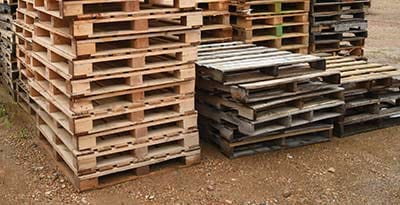
Wood pallets stacked in a warehouse

Wood Pallets

Wood pallets are the most widely used pallet type in North America — the standard for general warehousing, retail distribution, and manufacturing. They offer a practical balance of low cost, repairability, and broad compatibility with pallet racking systems, conveyor lines, and pallet flow rack. The standard GMA wood pallet measures 48" × 40" and is built from treated lumber to resist moisture and insects.

Wood pallets are either stringer-style (supported by 2"×4" boards) or block-style (supported by 4"×4" blocks at key positions). Block pallets allow four-way forklift entry; stringer pallets typically allow two-way entry. Most facilities use wood pallets as their default due to availability, low unit cost, and the ability to repair broken boards rather than replacing the entire pallet.

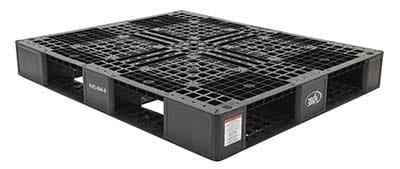
Plastic pallets in a distribution center

Plastic Pallets

Plastic pallets are manufactured from recycled and recyclable molded plastic. They are the preferred choice for food processing, pharmaceutical, clean-room, and export applications where hygiene is critical — plastic pallets contain no nails, splinters, or fasteners and can be fully washed, sanitized, or pressure-steamed between uses. They are FDA and USDA approved for direct food contact in most configurations.

Plastic pallets are lighter than wood (typically 15–30 lbs.) but more expensive per unit. They are highly durable, do not absorb moisture, and resist mold and bacteria. In closed-loop distribution systems where pallets return to the same facility, plastic pallets offer a lower total cost of ownership over their lifespan than wood pallets replaced on a one-way basis.

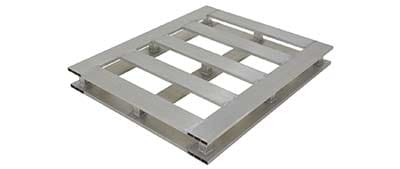
Aluminum and steel metal pallets

Steel & Aluminum Pallets

Metal pallets — built from welded steel or aluminum — are used in the food, pharmaceutical, rubber, and chemical industries, as well as in high-temperature environments like foundries and autoclaves where wood and plastic would be damaged or unsafe. They offer exceptional load capacity, often rated at 2,000–5,000+ lbs., and maintain structural integrity under conditions that would destroy other pallet types.

Aluminum pallets are lighter than steel (25–50 lbs. vs. 50–80 lbs.) and are rust-proof, fire-resistant, and fully recyclable. Steel pallets are the heavier option but offer maximum impact resistance for extremely demanding environments. Both types are easy to clean, sterilizable, and have lifespans measured in decades rather than years.

Pallet Construction Types — Stringer vs. Block

Beyond material, pallets are classified by how they are constructed internally. The two primary structural types are stringer pallets and block pallets, and the difference affects forklift compatibility, load capacity, and racking performance.

Stringer Pallets

Stringer pallets are the most common type in North America. They use two or three continuous boards — called stringers — running the length of the pallet to support the top deck. Stringers are typically 2"×4" or 3"×4" lumber. Standard stringer pallets provide two-way entry for forklifts (from the ends only), though notched stringer pallets allow limited four-way entry. They are less expensive to manufacture than block pallets and are the default format for most GMA pallets.

Block Pallets

Block pallets use cylindrical or square blocks — typically 4"×4", up to 12 blocks per pallet — positioned at corners, edges, and center to support both top and bottom deck boards. This construction allows true four-way forklift entry from any side, making them faster to load and unload in high-throughput environments. Block pallets are generally stronger than stringer pallets and perform better in automated storage systems. They are more expensive to produce and slightly heavier than comparable stringer pallets.

Stringer vs. Block Pallets — At a Glance

Stringer Pallet Block Pallet
Forklift entry 2-way (4-way if notched) True 4-way
Construction 2"×4" or 3"×4" stringers 4"×4" blocks at key positions
Strength Standard Higher
Cost Lower Higher
Best for General warehousing, one-way shipping Automation, high-throughput, closed-loop

Standard Pallet Sizes

Most pallet racking systems, conveyor lines, and automated storage equipment are designed around the 48" × 40" GMA standard. Before selecting a pallet, confirm that your storage system and handling equipment are compatible with the pallet dimensions you plan to use — a non-standard pallet in a standard rack configuration can create unsafe overhangs or forklift clearance issues.

48" × 40" GMA Standard

The most common pallet size in North America, used by grocery, retail, and general distribution. Compatible with the majority of selective pallet racking, pallet flow rack, and conveyor systems. The default size assumed by most U.S. warehouse designers.

42" × 42" Telecom & Paint

Common in the telecommunications and paint industries. Square footprint allows rotation without repositioning. Less common in standard racking systems — verify beam length compatibility before use.

48" × 48" Drum & Chemical

Used in chemical, paint, and drum storage applications. The larger footprint accommodates round containers and 55-gallon drums. Requires wider bays than standard GMA rack configurations.

40" × 40" Beverage

Standard for the beverage and dairy industries. Smaller footprint than GMA — two pallets can often fit in a bay designed for one GMA pallet with beam adjustment.

When in doubt, design your storage system around the 48" × 40" GMA standard. SJF's warehouse design team can help you configure racking layouts for any pallet size or mix of sizes in a single facility.

How Pallets Work in Warehouse Storage Systems

Pallets don't operate in isolation — they are the basic unit of load that every warehouse storage system is designed around. Pallet racking is built to hold standard pallets on beam levels accessible by forklift, with beam length and upright depth matched to the pallet dimensions being stored. Pallet flow rack uses gravity-fed roller lanes sized to the pallet footprint, allowing FIFO rotation in high-density pick operations. Conveyor systems transport pallets between receiving, storage, and shipping areas, with lane widths and roller spacing matched to the pallet's dimensions and weight.

Because so much equipment is sized around the 48" × 40" GMA standard, using non-standard pallets in an existing facility can require beam adjustments, conveyor lane modifications, or forklift attachment changes. If you are designing a new facility or reconfiguring an existing one, specifying your pallet size early is one of the most important decisions in the process — it determines beam lengths, aisle widths, and storage density across the entire layout.

Buy Pallets from SJF

SJF Material Handling stocks new pallets available for immediate shipment through our online store. Whether you need a single pallet style or a mixed order, our team can help you find the right product for your application and storage system.

Plastic Pallets

New plastic pallets in stock and ready to ship. Available in nestable and stackable configurations with four-way entry. FDA-compliant options available for food and pharmaceutical applications. Multiple weight capacities and footprint sizes in stock.

Shop Plastic Pallets →

Aluminum Pallets

New aluminum pallets available for immediate shipment. Lightweight, rust-proof, and fully recyclable — the right choice for heavy-duty, sanitary, or high-temperature applications. Contact SJF for current inventory and volume pricing.

Shop Aluminum Pallets →

Frequently Asked Questions

  • What is a pallet?

    A pallet is a flat, portable platform used as a base for storing, assembling, and transporting goods. Pallets are designed to work with forklifts, pallet jacks, and front loaders, which insert their forks into openings beneath the deck to lift and move loaded goods. They are a foundational component of warehouses, distribution centers, and logistics operations worldwide.

  • What is the difference between a pallet and a skid?

    A pallet has both a top and bottom deck connected by stringers or blocks, which gives it four-way or two-way forklift entry depending on the design. A skid has only a single top deck with no bottom boards — it sits directly on the floor or on runners. In practice, the terms are often used interchangeably, but they are technically different products with different handling characteristics.

  • What is the standard pallet size?

    The most common pallet size in North America is 48" × 40", also known as the GMA (Grocery Manufacturers Association) pallet. This is the standard size used in most pallet racking systems, conveyor lines, and pallet flow rack. Other common sizes include 42" × 42", 48" × 48", and 40" × 40", depending on the industry and application.

  • What type of pallet should I use — wood, plastic, or metal?

    Wood pallets are the most cost-effective and widely used option for general warehousing and shipping. Plastic pallets are preferred in food, pharmaceutical, and clean-room environments where hygiene and washability are required. Metal pallets — steel or aluminum — are used for extremely heavy loads, high-temperature environments, or applications requiring maximum durability and longevity. The right choice depends on your load weight, storage system, handling environment, and budget.

  • How much weight can a pallet hold?

    Weight capacity varies significantly by pallet type and construction. Standard wood pallets typically hold 1,500 to 3,000 lbs. when used in racking (static capacity) and up to 1,000 to 1,500 lbs. in dynamic use (being moved by forklift). Plastic pallets range from 1,000 to 3,000 lbs. depending on construction. Metal pallets can handle 2,000 to 5,000 lbs. or more. Always verify the manufacturer's rated capacity for your specific pallet before loading.

  • What is a GMA pallet?

    A GMA pallet is a 48" × 40" wood stringer pallet that meets the specifications established by the Grocery Manufacturers Association. It is the most widely used pallet standard in North America and is the default size assumed by most pallet racking systems, conveyor equipment, and automated storage systems. When someone refers to a "standard pallet," they almost always mean a GMA pallet.

  • Are pallets reusable?

    Yes — wood, plastic, and metal pallets are all reusable. Wood pallets can be repaired when boards break or stringers crack, extending their lifespan. Plastic pallets are highly durable and can last 10 or more years in closed-loop systems. Metal pallets have essentially indefinite lifespans with minimal maintenance. Single-use or expendable pallets also exist for one-way shipments where return logistics are impractical.

  • Does SJF sell pallets?

    Yes. SJF stocks new plastic and aluminum pallets available through our online store at shop.sjf.com. We also carry a range of material handling equipment — including pallet racking, conveyor systems, and pallet flow rack — designed to work with standard pallet dimensions. Contact SJF to discuss what pallet type and storage system fits your operation.

  • What are pallets used for?

    Pallets are used in warehouses, distribution centers, manufacturing facilities, and logistics operations to store, organize, and transport goods efficiently. Common uses include: storing product in pallet racking systems, moving loads by forklift or pallet jack, transporting goods along conveyor lines, staging raw materials in manufacturing, and shipping freight on trucks and carriers. The pallet is the standard unit load in virtually every supply chain — almost any goods that move through a warehouse at volume will spend time on a pallet.

  • How do you spell pallet? What are common misspellings?

    The correct spelling is pallet. Common misspellings include palet, pallete, pallette, pallett, pallot, oallet, and pallette. A palette (with an "e") is a completely different word — it refers to an artist's color-mixing board or a range of colors in design. A palate refers to the roof of the mouth or one's sense of taste. In warehousing and logistics, the correct term is always pallet.